
The Kingdom Mindset
How evangelical kingdom theology became a political project

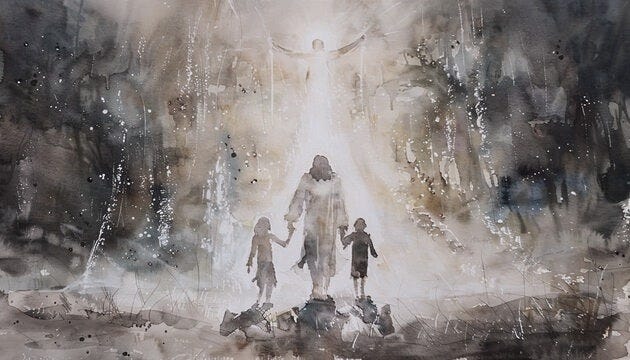
“Lord, give me a kingdom perspective. Give me a kingdom mindset.” I prayed, and I prayed, and I prayed, without ceasing, exactly as I was told to. A “kingdom mindset” was presented as a form of spiritual maturity, but over time, it has taken on an ideology of its own and permeated Christianity. What once seemed like fringe theology has now been cemented and taught as if it were part of the gospel. I was born and raised inside the cult of Christian nationalism. We would not have called it that then, and even now, the people I was raised by would resist that label in order to distance themselves from the stigma attached to it. But refusing the label does not change its structure. It is how I grew up, and it is a cult.
Within this ideology, the idea that the Kingdom of God is literally pulled from heaven to earth is central. The belief holds that if Christians can establish God’s kingdom here, society will transform into a utopian order where Christians freely worship God without constraint or persecution. Growing up immersed in this concept felt like living inside a large plexiglass barrier that moves and adapts with me. I could see and interact with the outside world, though I was taught I was in the world, but not of the world. This plexiglass symbolized the Kingdom, and my spiritual duty was to bring more of heaven down to expand this boundary and cover more territory.
Another way to describe this kingdom theology is through the Seven Mountain Mandate. I've written about it before, but simply put, it teaches that Christians should gain influence over the seven societal pillars, or "mountains"—family, religion, education, media, entertainment, business, and government—to establish God's rule on Earth. The aim isn't just to participate in these spheres but to control them in Jesus' name. The belief is that once Christians take control of these cultural strongholds, society will align with biblical authority.
The political approach to this goal is increasingly evident. Leaders in the Christian nationalist movement think they can accomplish it through coordinated efforts, such as government restructuring initiatives, as well as through the Heritage Foundation's Project 2025 and Project 2026. These proposals for reconfiguring federal authority are consistent with the dominionist view that Christians should control institutions and reshape society according to biblical principles.
Lance Wallnau is a prominent figure promoting this theology today. He describes himself as a prophet and apostle connected to the New Apostolic Reformation and has played a key role in turning dominion theology into a political strategy. Wallnau is known for popularizing the Seven Mountain Mandate, encouraging Christians to dominate seven societal spheres to establish Christian influence. Since 2015, he has been a vocal supporter of Donald Trump, likening him to the biblical King Cyrus—an outsider God used to fulfill divine plans. Through his podcast, YouTube channel, conferences, and revival-style political events like the “Courage Tour,” Wallnau energizes evangelical voters by blending Pentecostal revival language with electoral tactics. These events gather poll workers, share voter data, and motivate Christians to engage in politics through the lens of spiritual warfare. He was also among the charismatic prophets who predicted Trump’s 2020 victory and later claimed the election was stolen when that prediction did not come true. Despite numerous failed predictions and conspiracy theories, he maintains a large following and positions himself as a prophetic leader, guiding Christians in their mission to influence the “seven mountains” of culture.
For those of us raised inside this world, this worldview did not arrive through policy papers or political organizing. It arrived through worship music. I remember a song that was popular when I was a teenager:
We Wanna See Jesus Lifted High. The lyrics seemed harmless on the surface:
“We wanna see Jesus lifted high, a banner that flies across this land.” But the message underneath was unmistakable. “Step by step we’re movin forward, little by little we’re takin ground. Every prayer’s a powerful weapon, strongholds come tumblin’ down.”
Growing up as children, teenagers, and young adults, we were instructed to pray aggressive and warrior-like prayers. Prayer was portrayed as a powerful spiritual weapon. Whatever we declared in Jesus’ name was meant to be ours to claim. As long as we remained in Christ, any territory we believed God granted us dominion over was open for us to occupy.
Megachurch pastors across the country, particularly those affiliated with the New Apostolic Reformation, continue to preach variations of Seven Mountain theology today. It is designed to seep into secular life and reshape it from within. The expectation is not simply coexistence with those outside the movement but eventual conformity. This theology operates inside a white male–dominated ecosystem that enforces strict gender hierarchies, complementarian doctrine, and rigid binary thinking about authority, identity, and power.
Despite its language about God’s kingdom, this framework is not democratic in any meaningful sense. In theory, believers say the Kingdom is governed by the Holy Spirit. In practice, that voice is interpreted and filtered through the authority of white male pastors, apostles, and prophetic leaders who claim to speak on God’s behalf. Authority flows downward from those who say they have received divine revelation. Disagreement becomes rebellion against God. There is no democratic mechanism inside this structure because the leaders at the top claim that their authority comes directly from heaven itself.
And as the cultural influence of evangelical Christianity continues to fracture, the urgency of this messaging has intensified. The language grows sharper, the calls for dominion more explicit, and the systems designed to reinforce control more visible. Increasingly, this theology does not exist only in church pulpits but in adjacent ecosystems that shape culture itself: the online manosphere, the revival of “tradwife” ideology, and a broader reactionary movement that reframes patriarchal authority as divine order. Understanding how those cultural narratives are being cultivated and deployed is essential to understanding the future of Christian nationalism.
Kingdom theology is often seen as a harmless spiritual goal, a way for believers to align their lives with God’s will. However, the version that has gained ground within modern evangelical power structures is something very different. It is a governing framework that combines spiritual authority with political power and eliminates the safeguards that democracy relies on. When leaders claim to speak for God, disagreement is not just debate; it becomes rebellion against divine order. This is what makes this theology so dangerous in a democratic society. What seems, at first glance, like revival language about faith and prayer is actually a long-term plan for cultural conquest. To understand the future of Christian nationalism in the United States, we need to examine the belief system behind it. That belief system is kingdom theology.
Christian Nationalism is actively working to attack press freedom. This publication and similar outlets remain independent thanks to supportive donations. As a reader-supported platform, we rely solely on subscriptions to keep running. Please consider subscribing monthly or annually to support us.
Sources
“Who is Lance Wallnau and why is J.D. Vance joining his Courage Tour in Pennsylvania?” Ohio Capital Journal, September 30, 2024.
https://ohiocapitaljournal.com/2024/09/30/who-is-lance-wallnau-and-why-is-j-d-vance-joining-his-courage-tour-in-pennsylvania/
“Trump prophet Wallnau sells gold and silver while defending failed predictions.” Baptist News Global.
https://baptistnews.com/article/trump-prophet-wallnau-sells-gold-and-silver-while-defending-failed-predictions/
I so resonate with your articles. After much encouragement by friends I have finally started posting articles myself. Peace
They are working to destroy the foundations of this country.
They do not believe in democracy, free speech, or the separation of church and state.
We were most definitely not founded as a "Christian nation".